Vision
Epithalon and the retinal studies
The human eye report deserves room of its own. A later cell experiment opens a different question about the retina.
Retinitis pigmentosa: the human series
The 2002 retinal paper reported a clinical series of 162 people with retinitis pigmentosa. Approximately 90% had positive clinical outcomes.
The human proportion sounds extraordinary to me. Its meaning depends on how the outcomes were assessed and what would have happened over the same period without treatment. An uncontrolled series leaves that comparison unresolved. A controlled replication focused on the same disease and visual outcomes would strengthen this account.
The study reported no adverse events. Its size and design still leave rare or delayed harms uncertain. The study-amounts page records the route used in that series; it differs substantially from the laboratory exposures discussed elsewhere.
The rat retina
In rats, one eye measure lasted 43.9% longer.
That percentage concerns the persistence of a retinal measure in an animal model. It supplies no human lifespan estimate. On this point I’m persuaded: the retinal thread deserves follow-up, while the size of any human benefit remains a separate question.
Diabetic retinopathy: the cell model
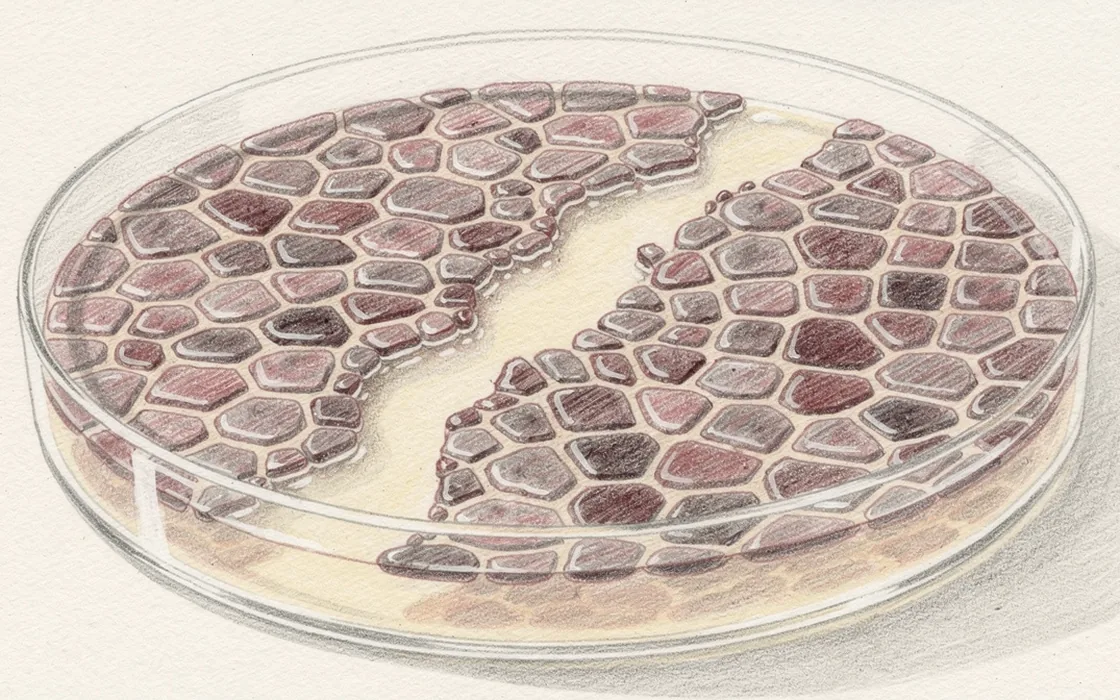
The 2025 wound-healing study examined cells in culture under high-glucose conditions. Researchers used retina-support cells known as line 19. The treated cells closed a test wound faster. The cells also handled harmful forms of oxygen better. The experiment also examined changes associated with fibrosis.
A retinal support-cell layer has a gap that can be watched as it closes. That is a useful, measurable event. A living eye adds circulation, nerves and other interacting tissues, and diabetic retinopathy differs from retinitis pigmentosa. These papers therefore cannot be pooled into one success rate for eyesight.
I trust this narrowly described experiment more than a general claim about “repair.” Its next test would be whether the proposed cellular changes help retinal function in a more complete model.
Retinal follow-up
For the human eye series, I’d begin with durability: how long do the reported visual changes last? Then come the comparison group, the definition of an improvement and the surveillance for harm. Those questions grow directly out of the observational retinal findings.
I’d place answers to those questions ahead of any attempt to make the retinal result stand for every ambition attached to Epithalon.